
Pookie, an internal redaction proxy, shows AI agents can build trusted code using specifications, tests, and records for fail-safe secret handling.
The main lesson from Pookie is not that an internal OVHcloud proxy was built in two weeks, or that 70% of its code is tests. The deeper lesson is that trust in AI-written code can be built by moving review away from line-by-line reading and toward specifications, decision records, and pass-or-fail signals. AI agents did not simply produce code. They were forced to interview, study prior work, prototype, implement against failing tests, and be reviewed by other agents.
What Pookie Does
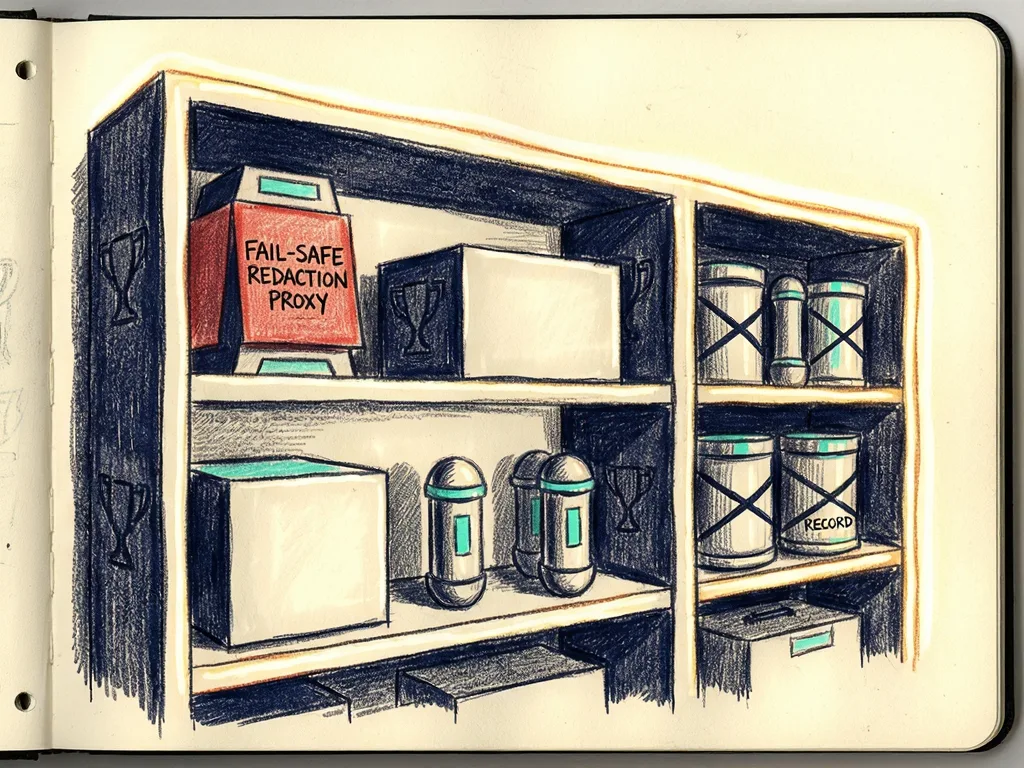
Pookie is an internal OVHcloud proxy that hides secrets from AI models. The article describes it as a redaction proxy. In this pattern, a secret is replaced with a placeholder, such as `__PK_HOST_3f2a…__`, when a request is sent to the model provider. When the answer returns, the real value is put back.
This sounds simple, but the operational risk is asymmetric. If a secret reaches the provider, it cannot be taken back. If a hidden value cannot be restored in the reply, the placeholder may still go back to the user’s own machine. Those two cases require different behavior, and Pookie was designed around that distinction.
The Core Judgment: Speed Is Not the Point
Two weeks to a first working version is a strong signal about AI-assisted development speed. However, the more important result is the 70% test ratio. Tests are not just coverage in this story. They are the trust model.
When AI agents write much of the code, a human cannot realistically review every line with the same depth as a small hand-written codebase. Pookie’s approach reduces that problem by making the agent prove behavior through tests first. The human reviews what the agent must prove: the spec, the tests, the decision records, and the failure modes.
Step 1: Let the AI Interview the Human
The author did not start by asking an agent for code. Instead, the first phase was about six hours of being questioned by an agent. The agent kept asking until the plan had no open questions left. Every answer became a written decision record. By the end, there were 54 decision records.
This workflow used open source skills from Matt Pocock’s agent skills collection, shared with the developer community. Two named skills are important:
- `Grill-me` interviews relentlessly about a plan until every branch of the decision tree is resolved.
- `Grill-with-docs` runs the same interview against existing documentation and writes decisions as they form.
The value is coverage. The AI asks questions that humans may forget. In Pookie’s case, one forgotten question reshaped the design.
The Invented Placeholder Problem
The original assumption was that every placeholder appearing in an AI answer had been created by Pookie. The unasked question was: what if the AI model invents a placeholder?
That happened. The model saw folder names full of placeholders, learned their shape, and tried to open sibling folders under names it made up. Nothing leaked, because no secret stood behind those invented names. But from an operator’s point of view, an invented placeholder looked the same as a lost real placeholder, and those cases need opposite responses.
A lost placeholder means investigating storage. An invented placeholder means nothing is wrong.
The design change was small but important. Each time Pookie stores a secret, it also writes a second, smaller record. That record contains no secret. It only says that Pookie created this placeholder, and when. That record lives four times longer than the secret itself, meaning 12 days with the default 72-hour lifetime. When an unknown placeholder comes back, Pookie can distinguish a real placeholder that expired from one the model made up. This avoids chasing a storage incident that never happened.
Fail-Closed Outgoing, Fail-Safe Incoming
The decision records also capture why certain choices were made. One example is the rule for outgoing requests. If Pookie cannot read an outgoing request completely, it blocks the request. The reason is that a secret that reaches the provider cannot be taken back.
For replies, the behavior is different. If Pookie cannot restore a hidden value in the reply, it lets the placeholder through and raises an alarm. The reason is that that text only goes back to the user’s own machine.
There is also no switch to turn this protection off. The team accepted that Pookie can stop an agent until a new provider format is supported. That is a trade-off: security posture over uninterrupted agent execution.
Step 2: Study Prior Art Before Building
While the interview was producing decision records, multiple agents studied similar open source tools, from secret scanners to existing AI proxies. For each tool, they wrote a short scout note covering what to borrow and what to avoid.
Pookie inherited a proven position in the request path and battle-tested detection patterns. It also made a deliberate break from some prior art. Secret scanners usually tune for precision, while Pookie tunes for recall. The reasoning is that a missed secret costs more than a hidden harmless value.
This is a useful design lesson for security-related AI tools. The correct objective depends on the failure cost. If false positives hide harmless text, the system is annoying. If false negatives leak secrets, the system has failed.
Step 3: Prototype to Answer One Question
Next came throwaway prototypes, built with the prototype skill from the same collection. Each prototype answered a single question, then was deleted.
The biggest question was language choice: Go or Rust? The agent could have written Pookie in either. The decision favored Go because most of a request’s time is spent waiting for the model provider’s answer. Rust’s extra speed was not worth its extra complexity for this use case.
This shows how prototypes can be used to reduce expensive debates. Instead of arguing about language preferences, the team built disposable code to test the decision against the actual workload shape.
Step 4: Give the Agent a Pass-or-Fail Signal
With specs and research in place, the agent received a feedback loop before it received a task. The loop was:
- Write a failing test.
- Let the agent implement until the test passes.
- Have separate AI agents review the code and its security.
- Run Pookie on a real repository to see what it catches and misses.
- Repeat until everything is green.
Tests make up 70% of the code, and that ratio is the trust model. The human does not review every line an agent writes. The human reviews what the agent must prove.
The author initially focused on reviewing specs and tests, not code. The move to code happened once something worked. That sequencing matters. Early code review can waste attention on behavior that has not yet been constrained by tests.
Most of what the reviews and real-repository audits surfaced was tuning rather than bugs. The delicate part is the balance between false positives and false negatives. Every rule that catches more secrets also hides more harmless values.
The Cost of Human Hand-Holding
One limitation is loop engineering. The author says that next time, more investment would go into the setup that lets the agent move from one feature to the next on its own. On Pookie, the author regularly stepped in to tell the agent which feature to build next.
That has a cost. If the agent ends up waiting for a human at 7:30 p.m. on a Friday, the team loses the whole weekend. This is a practical warning for AI coding workflows: fast local iteration is not enough if the agent cannot self-advance between tasks.
From Single Instance to Shared Service
Pookie started as a Docker Compose stack on a virtual machine instance in OVHcloud Public Cloud. It later moved to OVHcloud Managed Kubernetes Service, with Redis, to serve many users at once.
One engine now runs in four modes:
| Mode | Role |
|---|---|
| Command-line preview | Local inspection before shared use |
| Standalone binary | Single-process deployment |
| Docker Compose stack | Small or controlled deployment |
| Helm chart for the shared instance | Multi-user Kubernetes deployment |
A test with a fixed key checks that the proxy and the command-line tool produce byte-identical output. This is important because multiple deployment modes can drift apart unless there is a concrete consistency signal. The source notes that the cryptography and isolation behind Pookie are described separately in Pookie’s design.
Key Facts from the Source
| Area | Fact |
|---|---|
| First working version | Two weeks |
| Test share of code | 70% |
| Initial interview time | About six hours |
| Decision records created | 54 |
| Placeholder example | `__PK_HOST_3f2a…__` |
| Placeholder metadata lifetime | Four times longer than the secret |
| Default secret lifetime | 72 hours |
| Metadata lifetime with default | 12 days |
| Implementation language | Go |
| Rejected language | Rust |
| Deployment start | Docker Compose on a virtual machine instance in OVHcloud Public Cloud |
| Shared deployment | OVHcloud Managed Kubernetes Service, with Redis |
| Runtime modes | Four |
What This Means for Teams
The method fits into three habits:
- Let the agent interview the human until the plan has no gaps, and write every decision down.
- Make the agent study prior art and prototype before building.
- Give the agent a test it must pass before the human reads its code.
Spec-driven development with AI agents does not remove review. It moves review to the specs and tests, where one person can keep up. That is the practical advantage: humans supervise the contract, not every generated line.
For teams building similar tools, the reusable parts are not necessarily Pookie’s exact architecture. They are the workflow constraints. Interview before coding. Write decisions down. Study prior tools. Delete prototypes after they answer a question. Require a failing test before implementation. Use separate agents for review. Run against real repositories. Make deployment modes prove identical output.
Risks and Limitations
The story also has clear risks. The fail-closed design can stop an agent until a new provider format is supported. That means reliability and provider compatibility matter as much as security logic.
The false positive and false negative balance is never finished. Every rule that catches more secrets also hides more harmless values. The source says most review findings were tuning rather than bugs, which suggests the long-term work is calibration, not heroic debugging.
The human-in-the-loop problem is also real. If the agent must be told what to build next, productivity gains can collapse at the end of the workday. Loop engineering, or better autonomy between features, is the next efficiency frontier.
Practical Takeaway
Pookie shows that AI agents can produce useful production-adjacent software quickly, but trust comes from structure. The two-week timeline and 70% test ratio are visible results. The deeper result is a workflow where questions become decision records, prior art becomes a design input, prototypes become decision tools, and tests become the contract between human intent and generated code.
If a team wants to practice with a coding agent that keeps code and prompts in Europe, the source suggests connecting it to AI Endpoints through its OpenAI-compatible API.
FAQ
Was Pookie written entirely by AI agents?
The source says it was built with AI agents writing much of the code. It does not claim that every line was written without human involvement. The author also reviewed specs, tests, and later code.
Why are tests 70% of the code?
The source explains that tests make up 70% of the code and that this ratio is the trust model. The human reviews what the agent must prove, not every line.
Why choose Go instead of Rust?
The source says most of a request’s time is spent waiting for the model provider’s answer. Rust’s extra speed was not worth its extra complexity for this workload.
What happens if Pookie cannot restore a hidden value?
If Pookie cannot restore a hidden value in the reply, it lets the placeholder through and raises an alarm, because that text only goes back to the user’s own machine.
What happens if Pookie cannot read an outgoing request completely?
If Pookie cannot read an outgoing request completely, it blocks the request, because a secret that reaches the provider cannot be taken back.
Source: facts drawn from the supplied account; no external data added.
Last updated: no date provided in the source.
Reader notes 0
- No notes yet. Corrections and first-hand test results are welcome.