
Fluke survey links AI bottlenecks to internal power quality, distribution and cooling, not just grid supply, threatening dense GPU workloads.
Fluke's survey of 500 data center operators and professionals across the United States points to a narrower AI bottleneck than the usual power-supply story: internal power quality and electrical distribution. Nearly a third said power-quality issues have reduced their ability to deploy or operate high-density AI and GPU workloads. Only 36% said their electrical infrastructure is fully prepared for higher-density AI workloads, while 74% said insufficient power and grid capacity are moderately or severely limiting expansion. The implication is that securing electricity is necessary but not sufficient. A facility must also distribute, condition, cool, and monitor power reliably. Michael Stuart, senior manager and technical fellow at Fluke, told Data Center Knowledge that the biggest risk is whether a data center's internal infrastructure can reliably distribute and support that power at scale.
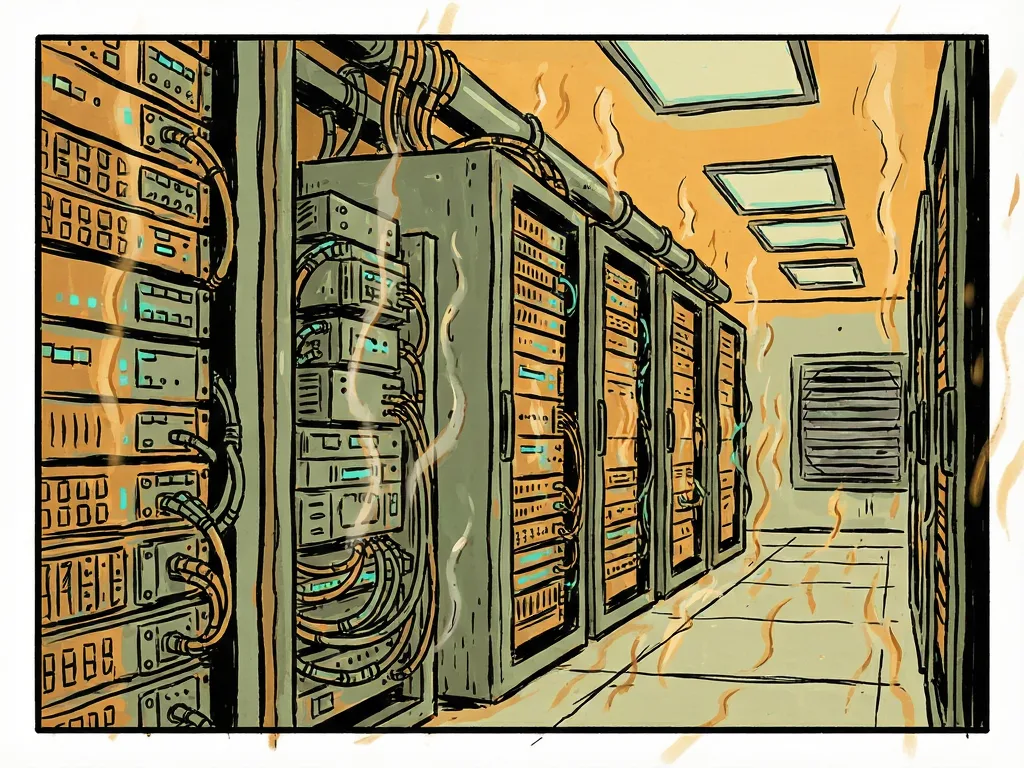
The survey shows two related but different constraints
The data separates external capacity pressure from internal electrical quality. The finding that 74% of respondents said insufficient power and grid capacity are moderately or severely limiting expansion shows that utilities and capacity availability remain major barriers. The survey also frames facilities as facing internal infrastructure constraints alongside the broader struggle to secure electricity from utilities. That second layer is where the power-quality findings matter. Nearly a third of respondents said power-quality issues have reduced their ability to deploy or operate high-density AI and GPU workloads. This does not necessarily mean the facility lacks electricity. It means the electricity reaching the workload may not behave in a way that supports stable computing.
| Reported finding | Figure | Short implication |
|---|---|---|
| Power-quality issues reduced AI and GPU deployment or operation | Nearly a third | Workload delivery can be limited by electrical behavior |
| Electrical infrastructure fully prepared for higher-density AI workloads | 36% | Readiness gap |
| Insufficient power and grid capacity limiting expansion | 74% | External capacity remains a constraint |
| Experienced electrical or power-system issues | 76% | About three-quarters reported problems |
| Power-quality issues contributed over the past year to delays, service disruptions, unplanned downtime, or serious near-misses | 79% | Risk surface includes near-misses, not only downtime |
| Lacked comprehensive, continuous, real-time visibility across critical electrical systems | 78% | Detection may be too limited |
| Problems identified only after performance degradation, equipment failure, or downtime | 15% | Reactive detection persists |
| Recruiting qualified electrical technicians has become harder | 57% | Installation, testing, and maintenance capacity under pressure |
| Skills shortages had not delayed infrastructure upgrades or new capacity | 65% | Workforce impact is uneven |
The 79% figure needs careful reading. It groups operational failures together with incidents that did not result in an outage. It does not mean that nearly four in five respondents experienced downtime. Its value is that it shows a broad risk surface: delays, service disruptions, unplanned downtime, and serious near-misses are all included, and power-quality problems have contributed to at least one of those outcomes over the past year.
Internal systems can waste secured grid capacity
Stuart said weaknesses often emerge where power, cooling, and cabling systems intersect. The named problems include harmonics, voltage sags and swells, thermal hotspots, deteriorating cooling systems, and infrastructure connections that have not been adequately documented or verified. Those conditions can limit the computing capacity a facility can support even after an operator has secured sufficient electricity. His point is direct: if electrical, mechanical, and network systems are not performing to specification, operators may be unable to fully utilize the capacity they have already secured from the grid.
The assessment is highly facility-specific. Because each data center is complex and diverse, Stuart said determining weaknesses within facilities should be done on a case-by-case basis. A condition that looks minor in one building may become significant under real GPU load conditions.
Measurement should follow the electrical path to the GPU load
For operators preparing to install high-density GPU racks, Stuart recommends measuring power quality as close as possible to the GPU loads along the electrical distribution chain. The practical reason is that measurements taken far from the load can miss the conditions the workloads actually experience.
The appropriate measurement points will vary by facility and may change during commissioning as actual load conditions become clearer. Electrical distribution and cooling also need to be evaluated together to establish whether they can sustain the intended workloads. If measurements reveal that either system cannot reliably support the intended GPU workloads, Stuart said operators should address those issues before proceeding with deployment.
This is a commissioning-sequencing issue rather than a single measurement point. The risk is that a facility may be commissioned with unresolved electrical or thermal weaknesses that later limit capacity, trigger disruptions, or require rework.
Monitoring gaps and workforce pressure shape reliability
The survey also found visibility gaps. Some 78% of respondents said they lacked comprehensive, continuous, real-time visibility across critical electrical systems. Another 15% said electrical problems were identified only after performance degradation, equipment failure, or downtime had already occurred. These findings point to two failure modes: limited coverage and late detection.
Stuart said operators should assess existing monitoring coverage to identify where additional visibility would most improve reliability. Potential areas include power distribution, backup power, batteries, and switchgear, although priorities will depend on each facility's infrastructure and current monitoring capabilities.
Workforce constraints add another layer. Recruiting qualified electrical technicians has become harder for 57% of respondents, adding pressure to teams responsible for installing, testing, and maintaining infrastructure. However, the hiring difficulty has not uniformly translated into slower expansion. Some 65% of respondents said skills shortages had not delayed infrastructure upgrades or new capacity.
Stuart said workforce constraints can still contribute to localized delays, inconsistent installation practices, and additional work to correct problems or verify quality. He also warned that not every problem is visible during an initial inspection; some only surface once electrical systems are operational. Qualified electricians should perform and validate the work, supported by testing and diagnostic tools to identify faults that may emerge after installation and help ensure long-term reliability.
Limits of the findings and reader takeaway
The figures are self-reported survey responses from 500 data center operators and professionals across the United States. They do not measure every facility's electrical capacity, and they do not establish a single failure pattern for all AI deployments. The 74% and 36% figures reflect respondents' views on capacity limitation and readiness. The 79% figure includes near-misses as well as operational failures, so it should not be treated as a downtime rate.
For operators, the practical sequence is clear: secure power, measure near GPU loads, evaluate distribution and cooling together, close monitoring gaps, and validate installations through qualified electrical work and diagnostic testing. For buyers, the message is that AI capacity depends on the reliability of the internal electrical path, not only on the amount of secured power.
Source: Fluke survey of 500 data center operators and professionals across the United States, as reported by Data Center Knowledge. Statements and recommendations attributed to Michael Stuart, senior manager and technical fellow at Fluke.
Last updated: 2026-06-22.
Reader notes 0
- No notes yet. Corrections and first-hand test results are welcome.