
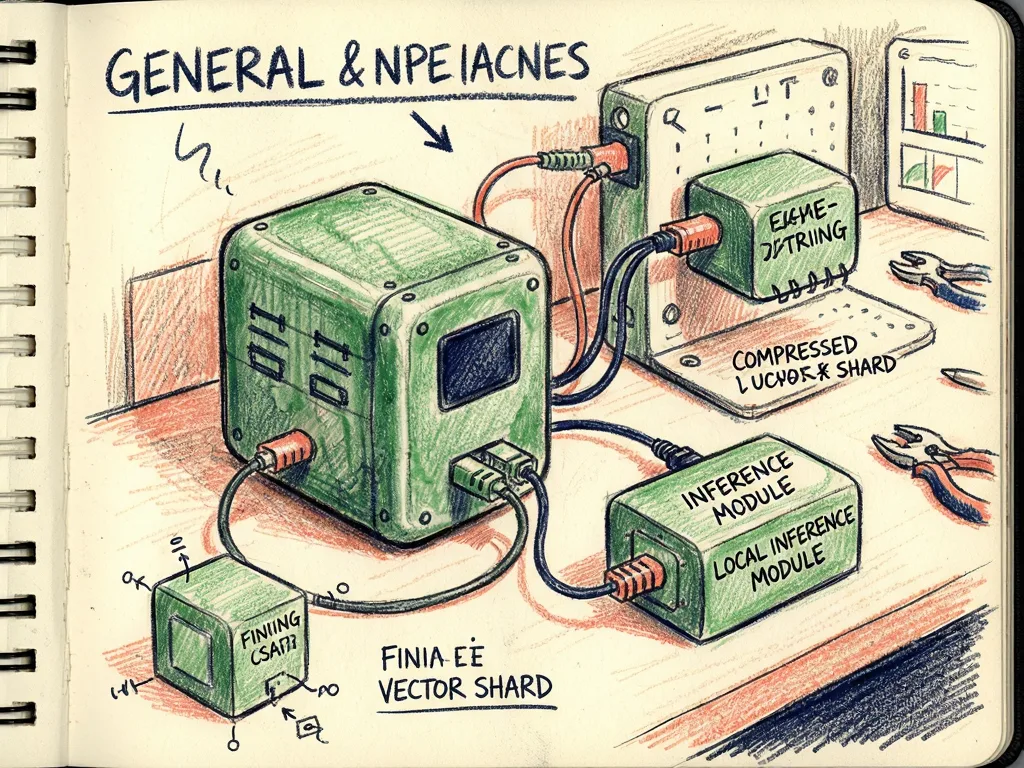
QVAC enables local inference, fine-tuning, and compressed vector search, letting apps run AI without cloud services, fees, or rate limits.
Tether’s QVAC SDK, released in 2026, describes a reversal of the dominant local AI pattern. Instead of sending user data to a third-party API, paying per request, and hoping the connection holds, the models run directly on the user’s device. Data never leaves the hardware, there are no per-request costs, no rate limits, and no need for an internet connection once a model is downloaded. The key increment is not only inference: the kit combines Fabric for on-device fine tuning with TurboVec for compressed retrieval, while QVAC Psy adds lightweight models that fit phones and personal computers. The counterweight is equally clear: open-source tools and standards like llama.cpp, GGML, and ONNX made local AI much more accessible in recent years and created new possibilities for consumer devices, yet the edge AI ecosystem remains fragmented.
What the SDK changes
The material positions QVAC as a way to pull together the best open tooling from across different domains of machine learning. Its centerpiece is Fabric, built on llama.cpp and described as expanding the engine to enable on-device fine tuning and additional AI capabilities. That opens access to memory-intensive workloads previously only possible with expensive hardware or cloud services.
Fabric also builds on GGML’s modular framework and is primarily oriented toward three backends: Vulkan, which covers most consumer-grade desktop and mobile chips; Metal and Core ML for Apple Silicon; and CUDA for higher-end NVIDIA GPU setups. The result is a unified interface for building multiplatform AI apps that run on-device.
This matters because local AI only works if it fits the hardware people actually own. Frontier-scale systems typically need data-center GPUs and hundreds of gigabytes of memory. By covering three backend families, QVAC tries to bridge consumer silicon, Apple silicon, and high-end NVIDIA systems. The benefit is developer reach. The risk is that performance still depends on the device, driver, and available memory.
Why retrieval is the harder problem
Significant progress has been made in bringing inference to consumer devices, but text generation alone is only one part of the pipeline that makes modern AI useful. Retrieval-augmented generation equips AI to import and process contextual information to enhance output. Instead of language models relying solely on their training data, the approach lets them answer using a specific set of documents.
The cost is significant memory overhead versus running a model alone. Retrieval-augmented generation requires the core language model’s inference, a second embedding model, and a specialized database system known as a vector index. These vector indexes can be huge, often much larger than the plain text files they represent and easily surpassing the RAM capacity of consumer hardware. As a result, most such operations are offloaded to the cloud, along with the user’s personal information. The material argues that vector indexing does not have to mean sacrificing privacy or getting locked into pay-per-token subscriptions.
In September 2026, the QVAC SDK integrated TurboVec, an open-source vector index that shrinks embedding memory usage by up to 8 times with 4-bit quantization. The stated effect is lower hardware requirements and a significant increase in search and retrieval speed. That paves the way for retrieval-augmented generation in offline, cloud-free apps that can access local databases without leaking personal information.
The practical reading is narrower than the promise. A compressed vector index still needs local storage, still needs updates, and still competes with the model and app for memory. The change is that the barrier becomes lower, not that the barrier disappears.
Lightweight models and proof point
To address hardware fit, the QVAC SDK integrates quantized versions of common open-source models. Tether has also developed its own lightweight models designed to run on a phone or personal computer and distributed peer-to-peer via its registry.
Those models form QVAC Psy, a family of specialized low-weight models that run on the QVAC SDK. Using specially curated training data, each model is trained to perform specific tasks at the same or a higher level than much larger AI platforms. The example is precise: the smallest variant of Tether’s translation model for African languages weighs in at just 800 million parameters and is said to have outperformed Google’s 27 billion parameter TranslateGemma on key benchmarks.
By pairing these compact models with other memory-saving features packed into the QVAC SDK, the material presents Tether as proving that local AI does not mean compromising on performance. Once apps can deliver real-world utility without massive data centers, users get unlimited, secure intelligence for free, without an internet connection.
For readers, this is the most concrete claim: narrow, well-trained models may beat much larger general systems on specific tasks. It does not say every model will win on every benchmark, nor that every consumer device will handle every workload.
Benefits, risks, and component map
Tether’s tooling is presented as potentially transforming how AI is built and used, with benefits for developers and end users alike. Without the burden of recurring API costs or expensive cloud hosting, independent creators and smaller studios can implement AI features that previously required enterprise-scale budgets. Processing sensitive information directly on local hardware also addresses privacy concerns and can help ease compliance with the General Data Protection Regulation and the Health Insurance Portability and Accountability Act, opening the door for secure AI apps in healthcare, legal, and financial sectors.
The material also invites developers to download the QVAC SDK, take full control of the application’s data, and join a growing community of builders rejecting the cloud. That is the appeal. The risk is that the stack depends on several moving parts: model quality, memory limits, backend support, and trust in peer-to-peer distribution.
| Component | Function | Incremental value | Limit to watch |
|---|---|---|---|
| QVAC SDK | 2026 software development kit pulling together open machine-learning tooling | Unified interface for multiplatform on-device AI apps | Device fragmentation and ecosystem support |
| Fabric | Engine built on llama.cpp and GGML, with Vulkan, Metal and Core ML, and CUDA backends | On-device fine tuning and memory-intensive workloads | Performance varies by hardware and driver |
| TurboVec | Vector index added in September 2026 | Embedding memory reduced by up to 8 times with 4-bit quantization | Local indexes still need storage and updates |
| QVAC Psy | Low-weight specialized models using curated training data | Task-focused models, including an 800 million parameter African-language translation model | Benchmark wins are specific, not universal |
| Registry | Peer-to-peer model distribution | Lightweight models can spread without central hosting | Trust and update governance are not detailed |
Reader takeaway
The strongest idea here is architectural: local AI becomes more useful when inference, fine tuning, retrieval, and lightweight models are packaged together. If it works, it can remove per-request cloud costs, reduce data exposure, and let apps run without an internet connection. The real test is whether the package stays fast and usable on the devices people actually own.
Reader notes 0
- No notes yet. Corrections and first-hand test results are welcome.