
Cato's AgentSense blocks AI agent actions influenced by untrusted content, cutting attack success to 0.05% in Agent Dojo tests with under 3% latency.
Cato Networks launched AgentSense this week as a new security capability inside its cloud-based secure access service edge platform. The company’s pitch is simple: AI agents need controls that act on their proposed operations, not only on the text of user prompts. The initial target is indirect prompt injection, where an agent follows instructions hidden in webpages, emails, documents, or tool responses and then misuses legitimate access. The launch is notable because it treats agent autonomy as a governance problem: an agent can have the right permissions and still be steered into harmful actions.
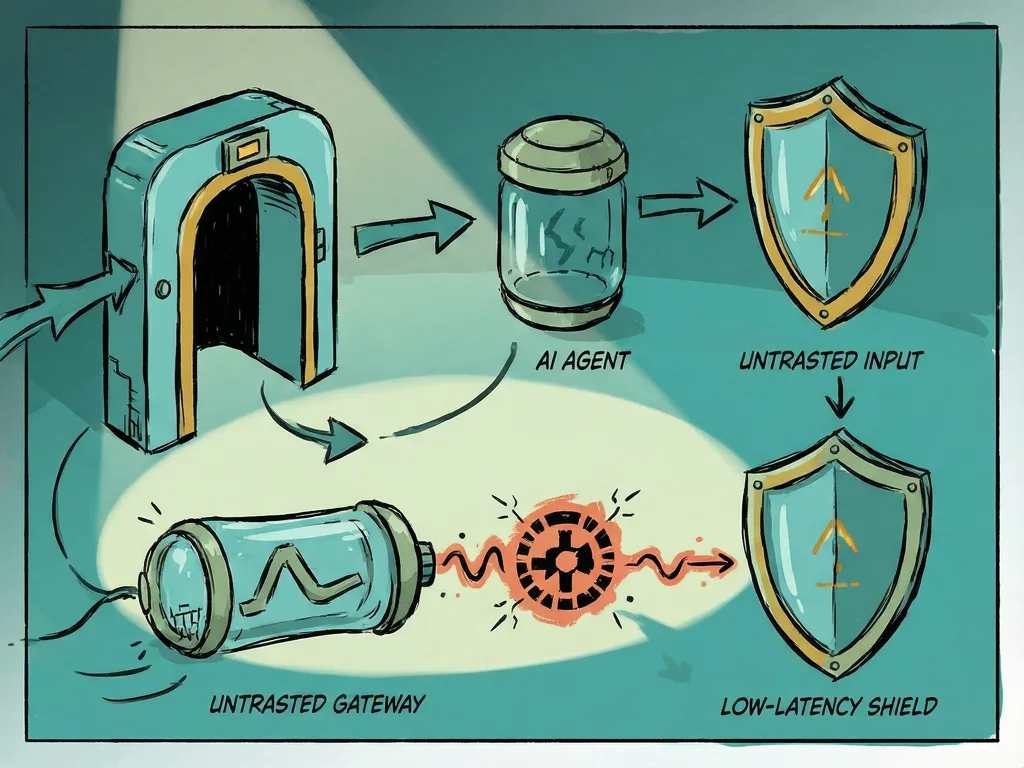
The core risk: a routine task becomes a harmful action
Cato says the first release focuses on a scenario in which an agent is doing a legitimate job while reading material that contains hidden instructions. The source of those instructions may be ordinary work content: a webpage, an email, a document, or a response from a tool. If the agent already has access to company data and tools, those instructions can push it to expose sensitive information or make an unauthorized change, even though the user’s original request was routine.
That framing matters for readers because it moves the security question from “Is the prompt malicious?” to “What is the agent about to do, and what influenced that action?”
Cato quoted Shlomo Kramer, CEO and co-founder, in a press release: “Giving agents greater autonomy requires security that can intervene before their actions cause harm.” He added: “Our vision for AgentSense is to give enterprises the confidence to put agents in charge of critical business processes while retaining control over how they operate.” In the launch briefing, Kramer also said agents “can have exactly the right permissions and still do bad stuff.”
How AgentSense evaluates agent behavior
Cato developed Untrusted Influence Detection as the core mechanism. It is designed to distinguish trusted instructions from untrusted content within an AI session, trace how that content influences a proposed action, and block the action before it executes. The company says this approach can catch attempts that fall outside known attack patterns, which is a claim that should be read as a design goal rather than proof of universal coverage.
Administrators can enable AgentSense with a toggle in the Cato secure access service edge platform, and it works across AI agents, according to the company. The initial policy set includes three built-in rules:
| Built-in rule | What it covers | Why it matters |
|---|---|---|
| High-risk operation steering | Untrusted input pushing an agent toward a high-risk operation | Blocks actions where hidden content changes the risk posture |
| External exposure | Sensitive information about to be exposed externally | Targets data leakage even if the original task was benign |
| Critical resource changes | Changes to critical resources driven by untrusted input | Protects files, configurations, and other sensitive assets from unauthorized modification |
The example Cato gave is concrete. A developer asked Claude Code to set up a test environment. While gathering information, the agent read a webpage that directed it to modify a sensitive local file. AgentSense traced the proposed change back to the webpage and blocked it before Claude Code could modify the file. The setup was left incomplete. That outcome illustrates the tradeoff: the guardrail prevented the harmful action, but it also stopped the workflow.
What the benchmark numbers support, and what they do not
Cato reported that in its own testing on the Agent Dojo benchmark, AgentSense reduced the attack success rate from about 19% without additional protections to 0.05%, with less than 3% added latency. These are the strongest quantitative claims in the launch. They suggest that, in at least one measured environment, the capability can sharply reduce successful indirect prompt injection attempts while adding a small latency overhead.
Readers should still treat the numbers as vendor-reported benchmark results. The source does not describe independent validation, a broader test suite, false-positive rates, or how the guardrail behaves on non-agent workloads. The benchmark also does not establish that AgentSense will block every future injection technique, every workflow, or every enterprise deployment pattern. The company’s claim that it can catch attempts outside known attack patterns is therefore an important design assertion, not a guarantee of security.
Planned capabilities and remaining limitations
Cato said Drift Detection is planned and would check whether an agent’s actions still serve the user’s original task. Kramer said the goal is to block actions that drift from the original purpose the agent was tasked for. The company also plans controls for which resources an agent can reach, including the data it can access.
Those plans point to a broader shift from content filtering to action governance. A complete agent control system would likely need to combine influence detection, task-purpose alignment, resource scoping, and policy enforcement. AgentSense’s first step addresses one layer: detecting when untrusted content is driving an action. Future resource controls may address the blast radius, while drift detection may address whether the agent is still doing what the user asked for.
The limitations are not merely technical. The launch includes no detailed public description of how false positives are measured, how administrators tune rules beyond the toggle and three built-in rules, or how the system handles agents that need multi-step planning across trusted and untrusted sources. The incomplete setup in Cato’s own example shows that prevention and availability can conflict: blocking a risky action may prevent the agent from finishing a legitimate task. Enterprises will need to decide whether that is acceptable for high-value workflows.
Availability and licensing
AgentSense is available to Cato customers and is included at no additional charge with Cato AI Usage licenses. That packaging places the capability inside an existing platform license rather than presenting it as a standalone product, which may reduce friction for customers already using Cato’s secure access service edge platform.
Why the $10,000 challenge matters
Cato also opened a public challenge to test an AI agent workflow protected by AgentSense. The first three eligible participants to complete the challenge will each receive $10,000, and the company said it would use participants’ findings to evaluate and improve the guardrail.
This is a useful signal. A bug bounty or public challenge can reveal edge cases that internal testing misses, especially in areas like prompt injection where small changes in content, tool behavior, or agent reasoning can produce unexpected results. It also means the product is not being presented as fully finished. The planned Drift Detection and resource-control work, plus the challenge, suggest Cato expects the capability to evolve as attack patterns and agent architectures change.
What this means for enterprises
For organizations experimenting with AI agents, the launch suggests that access management alone is not enough. An agent that can read the web, open emails, process documents, and call tools may be vulnerable to content that changes its behavior. Security teams may need to monitor not only who is using an agent, but what the agent is about to do and what content influenced that action.
The practical lesson is to start with the riskiest permissions. If an agent can change critical resources, access sensitive data, or make external requests, it should be treated as a privileged system. Even a routine task can become dangerous if untrusted content redirects it. AgentSense’s three initial rules map directly to those concerns: high-risk operations, external exposure, and critical resource changes.
Bottom line
Cato Networks has introduced AgentSense as a security layer for AI agent behavior, with a clear focus on indirect prompt injection and vendor-reported benchmark results showing attack success reduced from about 19% to 0.05% on Agent Dojo, with less than 3% added latency. The value lies in moving controls from prompts to proposed actions and using a public $10,000 challenge to test the guardrail. The uncertainty lies in scope: the source reports one launch capability, one benchmark, and planned features, not independent validation or comprehensive protection. Enterprises should view AgentSense as an early step toward agent governance, not a final answer.
Sources: Cato Networks launch materials and briefing, as described in the source text.
Last updated: The source describes the launch as “this week”; no exact calendar date is provided.
Reader notes 0
- No notes yet. Corrections and first-hand test results are welcome.