
Bull displayed Intel Xeon Diamond Rapids packages on a liquid-cooled blade, emphasizing socket, memory layout, and networking at the conference.
At SC26 in Chicago, Bull’s Sequana XH31600 blade gave the clearest physical look at Intel Xeon Diamond Rapids packages that the source says were displayed. The important takeaway is not performance; it is packaging, cooling, memory layout, and networking choices in a live platform. Intel is described as doing a mini launch of its next-generation server CPU, and the Bull system is the one the source found with actual Diamond Rapids packages visible.
What was shown
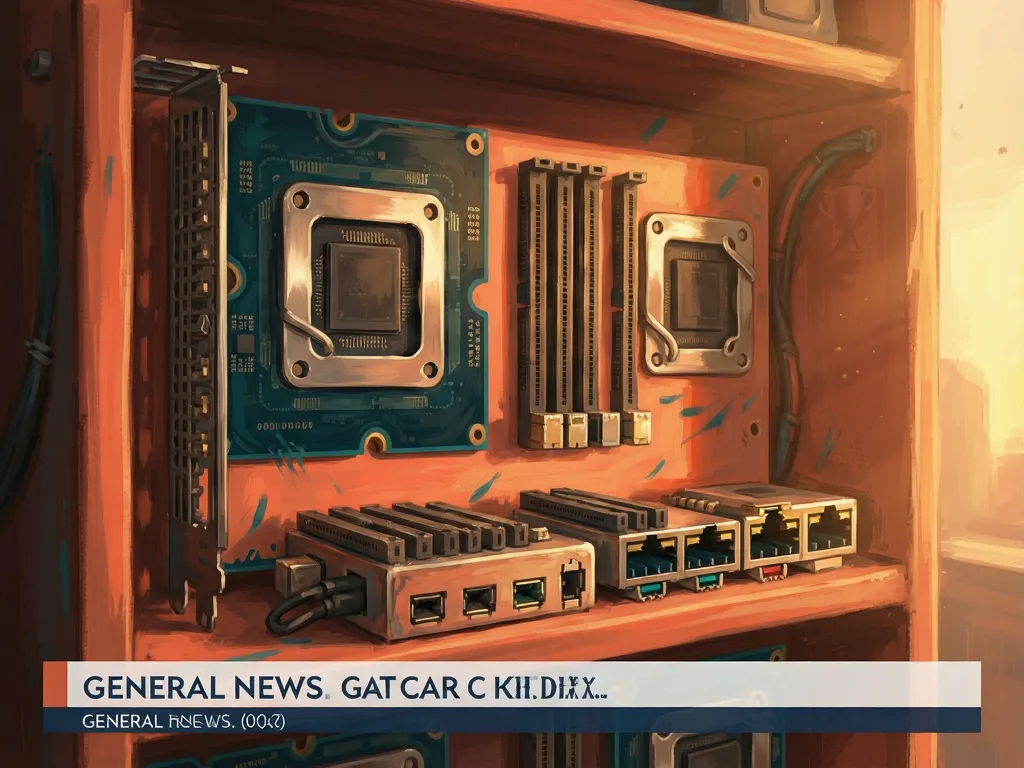
The compute blade had blind mate power and liquid connections at the rear, networking at the front, and four Intel Xeon Diamond Rapids packages up front. The source clarifies that this is not one quad-socket node. It is two dual-socket compute nodes, each with 16-channel memory. The CPUs sit on fairly wide motherboards because the memory channels are arranged on either side.
The socket is LGA9324, a land grid array socket. The source notes that this socket was already seen in the ASRock Rack DMRD16-2L+ from OCP Summit 2026. The difference at SC26 is that Bull displayed the package itself, while other vendors were showing boards and configurations.
Cooling and blade architecture
The blades are liquid cooled. The source points to heatpipes and liquid cooling blocks on the nodes. One node had the liquid cooling blocks and cabled connections to networking. The design is described as incredibly bespoke. Bull’s blade designs have been viewed as attractive for years partly because everything is liquid cooled.
A notable structural detail is the absence of a copper-cabled backplane in the rear. That is relevant because the source frames the current industry moment as one where NVIDIA is pushing Open Rack version 3, or ORv3, and AMD is now associated with double-wide designs, creating the appearance of a high-volume standard for high-density racks when power and cooling are the primary constraints.
Networking: Bull BXI and NVIDIA ConnectX-8
Networking showed two paths. Bull demonstrated BXI technology for interconnect. Its BXI switch had 64 octal small form-factor pluggable, or OSFP, ports at 800 Gbps, while the BXI network interface cards were shown as quad small form-factor pluggable double-density, or QSFP-DD, and PCI Express 5.0 x16. The source compares this to the review of NVIDIA ConnectX-8 C8240 800 Gbps dual 400 Gbps, a super network interface card, or SuperNIC, that used two PCI Express 5.0 x16 links to reach 800 Gbps.
Bull also had an NVIDIA ConnectX-8 SuperNIC in an Open Compute Project network interface card 3.0, or OCP NIC 3.0, form factor nearby. The source highlights the tension in that arrangement: Bull is showing its own interconnect, with a 51.2 terabits per second switch and a PCI Express 5.0 network interface card, in a platform described as having a sixth-generation CPU, while NVIDIA’s high-volume PCI Express 6.0 network interface card competitor sits right next to it.
Platform and launch context
The source says many other vendors are showing Diamond Rapids systems at SC26, including configurations with 32 dual in-line memory module sockets per CPU and two dual in-line memory modules per channel. Bull is described as the only vendor found so far with a package visible. Diamond Rapids is in the sampling phase.
The source gives an uncertain launch expectation: maybe a launch in the second quarter of 2027. If that slips past June, or if Intel uses a split launch with one-processor and two-processor platforms, the next real launch window identified is early September 2027.
Bull’s broader display also included SiPearl, Intel Xeon Diamond Rapids, NVIDIA, and AMD Venice nodes in a common form factor. The source says that with NVIDIA Vera Rubin designs in ORv3 racks, the Bull systems now fit into higher-volume AI infrastructure patterns. That is a change from earlier years, when a platform like this would have seemed far more unusual.
Comparison of the demonstrated elements
| Element | What the source showed | Why it matters |
|---|---|---|
| CPU visibility | Four Intel Xeon Diamond Rapids packages in a Bull blade | Provides physical evidence of package presence at SC26 |
| Node layout | Two dual-socket nodes, each with 16-channel memory | Explains the wide motherboard and memory arrangement |
| Socket | LGA9324, previously seen in ASRock Rack DMRD16-2L+ from OCP Summit 2026 | Connects the new package to an already documented socket platform |
| Cooling | Liquid cooling, heatpipes, cooling blocks, blind mate power and liquid at rear | Shows the blade is designed for dense thermal delivery |
| Networking | BXI switch with 64 800 Gbps OSFP ports; BXI network interface cards as QSFP-DD and PCI Express 5.0 x16 | Demonstrates Bull’s own interconnect path and its bandwidth approach |
| NVIDIA presence | ConnectX-8 SuperNIC in OCP NIC 3.0 form factor | Shows NVIDIA’s competing network interface card path in the same display |
| Launch status | Sampling phase; possible second quarter 2027 launch, or early September 2027 if delayed or split | Sets expectations for when products may become commercially available |
Neutral read on value and limitations
The value of this demonstration is physical and architectural. It shows how a Diamond Rapids package could be placed inside a liquid-cooled blade with dense memory channels, blind mate rear power and cooling, and front networking. It also shows Bull balancing its own BXI interconnect with NVIDIA networking hardware in the same environment.
The limitations are equally clear. The source does not provide performance data, clock speeds, core counts, thermal design power, memory speed, pricing, availability, or a confirmed launch date. The Diamond Rapids package is shown during sampling, so the final retail or enterprise configuration may differ. The launch timing is described as a best guess, not a confirmed plan. The comparison to the NVIDIA ConnectX-8 review is based on link count and bandwidth, not a benchmark result. The absence of a copper-cabled backplane is a design observation, not a claim about reliability or cost.
Questions a reader may have
Is Diamond Rapids already launched?
No. The source says it is in the sampling phase. A second quarter 2027 launch is the best guess, with early September 2027 identified as the next real launch window if the first timing slips or if Intel uses a split one-processor and two-processor launch.
How many CPUs were visible in the Bull blade?
Four Intel Xeon Diamond Rapids packages were visible, but they represented two dual-socket compute nodes, not one four-socket node.
What made the memory layout distinctive?
Each dual-socket node had 16-channel memory, and the motherboards were wide because memory was placed on either side of the CPUs.
What networking options were shown?
Bull showed BXI technology, including a BXI switch with 64 800 Gbps OSFP ports and network interface cards in QSFP-DD and PCI Express 5.0 x16 forms. It also showed an NVIDIA ConnectX-8 SuperNIC in an OCP NIC 3.0 form factor.
Why was the platform described as bespoke?
Because it combined liquid cooling, blind mate rear power and liquid, front networking, wide memory boards, and a rear without a copper-cabled backplane.
Source basis and update
The facts in this article come from the SC26 demonstration description supplied in the source. The source does not cite an official Intel specification sheet, benchmark, price list, or confirmed release date.
Last updated: SC26 demonstration notes.
Reader notes 0
- No notes yet. Corrections and first-hand test results are welcome.