
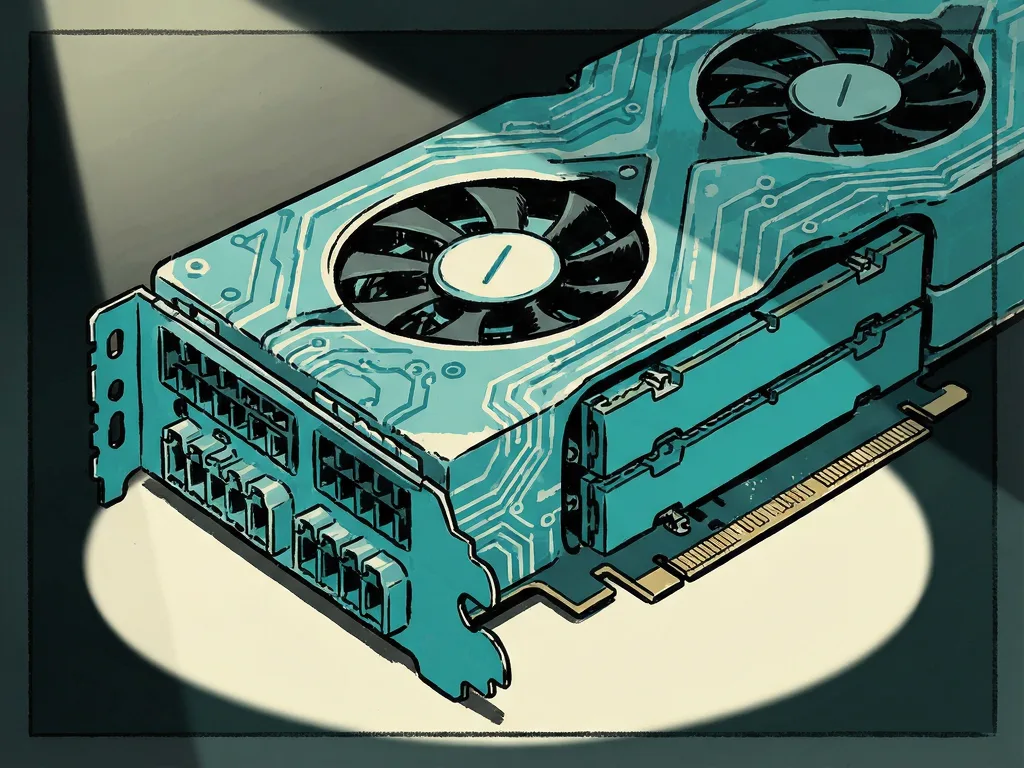
The ASUS Turbo Radeon AI Pro R9700 is a dual-slot blower card built around AMD's newest graphics architecture. It offers 32 gigabytes of video memory, 128 AI accelerator cores, and support for lower-precision math. Its 300 watt board power, rear power connector, and standard card size help dense multi-card workstation builds. It targets users needing professional display output and a budget entry under two thousand dollars into AMD's new Radeon AI Pro direction.
The ASUS Turbo Radeon AI Pro R9700 is less a conventional graphics card than a workstation building block for AI inference. Its main value is not raw peak power, but the combination of 32GB of video memory, a 300-watt dual-slot blower design, a rear power connector, and an overall form factor intended to let up to four cards fit in one system. That makes it most relevant for users who need a balance of professional display output, dense GPU installation, and a sub-$2000 entry point into AMD’s new Radeon AI Pro direction.
Market context: why a workstation AI card exists now
AI inference attention has largely moved toward servers and datacenter-scale deployments. Still, the modern AI revolution began with video cards, and that segment remains important even when it is overshadowed by server products.
AMD has made a visible shift in how it presents professional graphics. The former Radeon Pro workstation line has become the Radeon AI Pro line, and the Radeon AI Pro R9700 sits at the top of that effort. AMD and its partners position the R9700 as a more budget-friendly alternative to NVIDIA’s RTX PRO Blackwell lineup of workstation cards.
Another unusual point is that AMD is not selling its own reference-design workstation cards for this generation. Instead, partners such as ASUS sell their own versions. In the consumer market, that model is common, but for a workstation AI card it creates an interesting constraint: partners must produce cards that still fit AMD’s desired professional image, especially the ability to install multiple cards in one system.
What ASUS built
The ASUS Turbo Radeon AI Pro R9700 follows that workstation logic closely. It is a dual-slot blower card that measures 10.5 inches long and 4.4 inches high, and it adheres to PCI Express width and height specifications. That is not just a cosmetic choice. It is the key to the card’s promise of supporting multiple cards in a single chassis.
The card is powered by AMD’s Navi 48 GPU, which is the most powerful RDNA 4 GPU in this generation. It includes 64 compute units, 4096 shading units, and 128 AI accelerator cores. The peak clock speed is 2.92 gigahertz, giving the card a peak matrix math throughput of 382.7 teraflops with dense 8-bit floating point work, or twice that with sparsity.
That FP8 support matters. It improves compute throughput and aligns AMD’s hardware with a broader industry trend toward lower-precision weights, which can help fit more model data into a given amount of memory.
Specification summary
| Item | Detail |
|---|---|
| Product | ASUS Turbo Radeon AI Pro R9700 |
| GPU | AMD Navi 48 |
| Architecture | RDNA 4 |
| Compute units | 64 |
| Shading units | 4096 |
| AI accelerator cores | 128 |
| Peak clock | 2.92 gigahertz |
| Peak dense 8-bit floating point matrix throughput | 382.7 teraflops |
| Sparsity throughput | Twice dense FP8 throughput |
| Video memory | 32GB GDDR6 |
| Memory bus | 256-bit |
| Memory organization | 16 2-gigabit chips in clamshell mode |
| Memory speed | 20 gigabits per second |
| Memory bandwidth | 640 gigabytes per second |
| Total board power | 300 watts |
| Form factor | Dual-slot blower |
| Length | 10.5 inches |
| Height | 4.4 inches |
| Power connector | ATX 12V-2x6 |
| Connector rating | Up to 600 watts |
| Display outputs | 4 |
| Output configuration | 3 DisplayPort 2.1a, 1 HDMI 2.1b |
| Maximum stated display resolution | Up to 12K with display stream compression |
| Error correction | Soft error-correction code, only under Linux and manually enabled |
| Market positioning | Sub-$2000 workstation AI card |
Why the design choices matter
The most important number may not be the 32GB of memory, but the 300-watt total board power. That figure is central to the card’s identity. A 300-watt dual-slot blower card is easier to cool and easier to stack in a multi-card system than a much higher-power design. The source notes that this helps keep cooling manageable without excessive noise, and it also means four cards in one system will not create extreme power demands, though it may still push the limits of a single power supply.
The rear power connector is another practical workstation decision. The ATX 12V-2x6 connector is placed on the rear of the card instead of the top. That is a deliberate design choice for systems where multiple cards may be installed close together, because cable routing becomes easier and more predictable. The connector is rated for up to 600 watts, so the 300-watt card is well within its limits.
The open-backed blower design also fits the same logic. The card pulls air from both sides, and the rear of the PCB includes venting. That matters because the 32GB of GDDR6 memory is arranged in a clamshell configuration, with 8 memory chips on the rear of the card. Those chips still need protection and cooling, which is why the card includes a rear shroud and rear vents.
Memory capacity is the central trade-off
The R9700 has 32GB of GDDR6, which is the headline memory figure for this card. But it is also a step back from the previous-generation 48GB Radeon Pro W7900. The source explains that AMD did not produce a true high-end GPU this generation, and Navi 48 is a mid-to-high-end die size by AMD’s standards, with 357 square millimeters of die area and 53.9 billion transistors.
That creates a clear trade-off. The new card has less total memory capacity than the prior professional flagship, but AMD is trying to make up the difference with compute throughput and a newer architecture. In practical terms, this means the card may be well suited to workloads that fit within 32GB and can benefit from the newer compute features, especially lower-precision inference paths. It may be less attractive for users whose main requirement is the largest possible on-card memory capacity.
The memory bandwidth is 640 gigabytes per second, which is substantial for a 32GB GDDR6 configuration. Still, bandwidth and capacity are not the same thing. A workload that can use FP8 acceleration and fits within 32GB may benefit from the throughput story. A workload that simply needs more memory may still look at older or higher-capacity options.
Display output is still part of the product
Despite the AI branding, this is still a workstation graphics card. It includes four display outputs, which is the maximum number of displays the Navi 48 GPU can drive. The configuration is three DisplayPort 2.1a ports and one HDMI 2.1b port. With display stream compression, the card can drive displays at up to 12K resolution.
That matters because many AI workstation cards are not used only for compute. Users still need professional graphics output, multi-display support, and a card that can live in a desktop or rack workstation. The Turbo R9700 does not hide those requirements. The front of the card is dominated by venting, but it still includes a full professional display stack.
Strengths of the ASUS Turbo Radeon AI Pro R9700
The card’s strongest points are consistency and practicality.
- It is built around a clear workstation use case: multiple cards in one system.
- The 300-watt total board power supports dual-slot blower cooling more easily than higher-power designs.
- The rear power connector improves multi-card cable management.
- The 32GB of GDDR6 is a meaningful capacity point for workstation AI work.
- FP8 support and 128 AI accelerator cores give the card a clear AI inference story.
- The design follows AMD’s tightly constrained partner-card approach, which keeps form factors predictable.
- It remains a full graphics card with four display outputs, not just a compute accelerator.
Weaknesses and risks
The same design choices that make it practical also define its limits.
- It has less memory than the previous-generation 48GB Radeon Pro W7900.
- Soft error-correction code support is only available under Linux, and it must be manually enabled.
- Four cards in one system may still push the limits of a single power supply.
- The source does not provide real-world performance benchmarks, so actual results will depend on workload, software support, drivers, and whether the application can use FP8 and sparsity.
- The card is positioned as a more budget-friendly alternative to NVIDIA’s RTX PRO Blackwell lineup, but that is a positioning statement, not a guarantee of universal value.
- The blower design can keep multi-card systems feasible, but cooling and noise still depend on chassis airflow, system configuration, and the number of cards installed.
Who this card is for
The ASUS Turbo Radeon AI Pro R9700 makes the most sense for workstation users who need a balance of AI inference capacity, professional display output, and multi-GPU density. If the goal is to build a compact system with several cards, the dual-slot blower layout and rear power connector are major advantages.
It is less suitable for users whose primary requirement is maximum memory capacity above 32GB. It is also less suitable for users who need broad error-correction support across all operating systems, because the source specifies soft error-correction code only under Linux and only with manual enablement.
FAQ
Is the ASUS Turbo Radeon AI Pro R9700 a server card?
No. The source describes it as a workstation card. It is designed for add-in workstation use and for multi-card systems, not as a server or datacenter accelerator.
Can it be used with four cards in one system?
Yes, the card is positioned for that use case. The source states that it is balanced for workstation use and can fit up to four cards in a single system. The caveat is that power supply limits and chassis cooling still matter.
Does it have 48GB of memory?
No. It has 32GB of GDDR6. That is less than the previous-generation 48GB Radeon Pro W7900.
Can it drive 12K displays?
Yes, up to 12K resolution is stated, but only with display stream compression and within the card’s maximum of four display outputs.
Does it support error correction?
The source says soft error-correction code is available only under Linux and must be manually enabled.
Is it cheaper than NVIDIA RTX PRO Blackwell workstation cards?
The source says AMD and its partners are positioning the R9700 as a more budget-friendly alternative to NVIDIA’s RTX PRO Blackwell lineup. The card is also described as sub-$2000. That is a positioning and price-tier statement, not a guarantee of performance or market availability.
Sources and last updated
This analysis uses only the facts provided in the source review of the ASUS Turbo Radeon AI Pro R9700, including hardware specifications, pricing positioning, design details, and the comparison with AMD’s previous Radeon Pro direction. No additional benchmarks, availability data, regulatory context, or local market information were introduced.
Last updated: 2026-06-16
Reader notes 0
- No notes yet. Corrections and first-hand test results are welcome.