
Harvard study links 403 US AI data centers to 25.7 million metric tons of carbon, showing grid mix, location, and clean power drive emissions.
The most important point in the Harvard-led study is not simply that AI is raising data center electricity demand. It is that the environmental footprint of that demand is being decided by the power systems built around new computing campuses. The study connects electricity used at 403 US hyperscale data centers with an estimated 25.7 million metric tons of carbon dioxide emissions over one year. The central electricity estimate is 82 terawatt-hours, or about 1.8% of total US electricity use, with roughly 54% of the electricity serving those sites generated from fossil fuels.
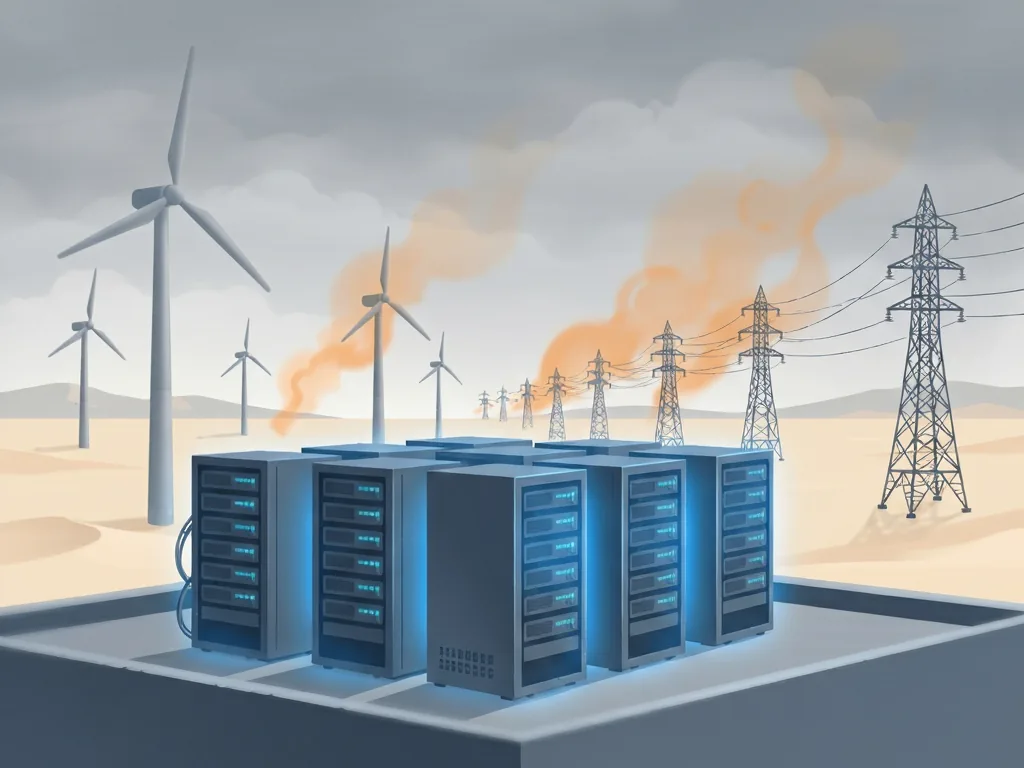
Core judgment: the carbon math follows the grid mix
The findings shift the debate from machine efficiency alone to procurement, location, and timing. Gianluca Guidi, a Harvard scientist and lead author of the study, said AI is rapidly increasing demand for computing infrastructure and creating substantial new electricity demand. He argued that the climate consequences depend on how quickly the electricity system can respond with low-carbon generation.
That framing matters because data centers are not automatically responsible for the carbon intensity of the grid, but their load is becoming large enough to shape grid outcomes. Faster computing and improved cooling can reduce energy use per workload even as total demand continues to rise. For developers racing to bring capacity online, the study puts power procurement and grid conditions alongside building efficiency as key determinants of emissions.
Dan Versace, a research analyst for environmental, social, and governance business services at IDC, told Data Center Knowledge he expected US data center emissions to more than double by 2030 as computing demand grows faster than clean electricity supply. He reduced the issue to three moving parts: how fast the load arrives, whether clean power is available where and when it is needed, and whether efficiency gains get absorbed by growth.
What the study measured and where uncertainty begins
The study, published Nov. 16 in Nature Sustainability, examined facilities operating from May 2024 through April 2025. It estimated electricity use through facility-load scenarios and assigned emissions based on regional generation data. The estimates cover the facilities studied, not the entire US hyperscale market, and include both general-purpose computing and AI workloads.
| Measure | Central estimate or range | What it means |
|---|---|---|
| Facilities analyzed | 403 US hyperscale data centers | A large but not complete view of the US hyperscale market |
| Electricity use | 82 terawatt-hours | About 1.8% of total US electricity use in the central estimate |
| Emissions linked to that electricity | 25.7 million metric tons of carbon dioxide | The central estimate associated with electricity use over one year |
| Fossil generation serving the sites | Roughly 54% | The carbon outcome depends heavily on local and regional grid mix |
| Scenario range for electricity | 68 to 99 terawatt-hours | Load assumptions materially change the consumption estimate |
| Scenario range for emissions | 21 million to 31 million metric tons of carbon dioxide | The central estimate sits inside a broad uncertainty band |
The range is important. A 68 terawatt-hour scenario and a 99 terawatt-hour scenario produce very different policy and planning implications. The study also does not claim that all US hyperscale emissions are captured by these 403 facilities. Its value is in showing how concentrated load, regional generation mix, and growth speed interact.
Regional concentration turns state infrastructure into a carbon variable
The Harvard summary noted that Virginia, Oregon, Ohio, and Iowa accounted for more than half of the electricity consumption analyzed. That concentration means the environmental footprint of expansion is not evenly distributed across the country. It is tied to specific regional grids, generation pipelines, and transmission decisions.
Guidi said the longer-term concern is clear: a data center built today could influence electricity infrastructure decisions for the next 30 to 40 years. His warning is that society should be careful not to address rapidly growing technological demand by locking in decades of additional fossil-fuel dependence.
Gordon Johnson, senior computational fluid dynamics manager at Subzero Engineering, put the issue in more operational terms. He said the source of incremental electricity will determine whether rising demand translates into higher emissions. If additional electricity comes from renewable or low-carbon sources, the emissions impact can be limited. If it comes from fossil-fuel generation, carbon emissions will increase.
That makes location a strategic variable. A campus in a region with abundant low-carbon generation may have a different emissions trajectory from one in a region where new load is met by gas plants or other fossil resources. The study’s regional data does not prove a single outcome for every facility, but it shows where the pressure is concentrated.
The timing problem: clean power must arrive when campuses open
A key reason emissions estimates rise is not only total demand, but the speed at which demand arrives. Clean power projects and grid upgrades must come online on timelines that align with new campus openings. When they do not, developers may have to choose from whatever generation options are available when facilities begin operating.
Katherine Otway, chief strategy officer at nonprofit incubator and accelerator The Engine, said those competing timelines are increasingly shaping operators’ power choices. She described a mismatch that is common in fast-moving infrastructure: a developer may already have an opening date while a startup developing a new power system is still proving its technology.
That mismatch can push some developers toward on-site gas turbines to meet opening schedules. For alternative technologies, commercial readiness depends not only on technical performance, but also on manufacturing, installation, and reliable operation. In other words, a promising power technology may be scientifically viable but still unavailable at the scale and speed required by a data center campus.
The timing issue also creates local risk. Johnson said where new generation is built matters, particularly for communities near power plants or in areas that may need additional generation capacity and could face higher air pollution. The study’s climate estimate does not capture those local health and air-quality concerns, but it helps explain why they may become more acute as large facilities concentrate load in certain regions.
Market-based reporting can obscure location-based reality
James Rogers Jones, head of sustainability development at BCS Consultancy, highlighted a reporting gap that can complicate public understanding. Operators may report low or net zero emissions using power purchase agreements and certificates, which reflect market-based accounting. County or city targets, by contrast, may look at the actual local grid mix, which reflects location-based accounting.
Those differing accounting approaches can create planning tensions. A developer may claim renewable-backed power in a corporate report, while a local government sees rising emissions attributed to local electricity demand. Neither number is necessarily false, but they measure different things. For readers trying to assess a data center’s environmental impact, the accounting method matters as much as the headline emissions claim.
Efficiency helps, but growth may absorb it
Efficiency is still a lever. Jones pointed to flexible electricity consumption, such as reducing load during peak demand or periods of low renewable output, as one way to better accommodate wind and solar. Versace said operators can already deploy measures such as power capping, carbon-aware scheduling, and improved cooling.
But the study’s authors and outside analysts agree that efficiency alone may not control total emissions if demand grows faster. Guidi said efficiency is essential, but it will not necessarily reduce total consumption if demand continues to grow even faster. More efficient chips, he noted, can enable more computation rather than simply reducing electricity use.
Versace’s outlook is similarly cautious. He said demand will outpace clean supply through at least 2028, but he framed that not as a failure of clean energy so much as a reflection of how quickly this load is growing. His broader expectation is that US data center emissions could more than double by 2030 if computing demand continues to outrun clean electricity supply.
Jones also cautioned that providing reliable power while preserving flexibility remains a challenge for large sites. Flexible load is attractive in theory because it can shift consumption toward periods when renewable output is high. In practice, large AI campuses may require dependable power for long workloads, making that flexibility harder to achieve.
Neutral read: what helps and what remains risky
| Lever | Potential benefit | Limitation |
|---|---|---|
| Improved chip efficiency | Lower energy use per workload | May enable more total computing rather than less electricity use |
| Better cooling | Reduces facility overhead | Does not remove the grid carbon intensity problem |
| Power capping and carbon-aware scheduling | Can align load with cleaner periods | Large sites still need reliable power and may face operational constraints |
| Renewable power purchase agreements | Can support low-carbon claims in market-based reporting | May not change the actual local grid mix at the time of consumption |
| On-site generation | Can meet opening schedules | If fossil-based, it increases emissions and may raise local air-quality concerns |
| New clean generation and storage | Can reduce the carbon intensity of incremental load | Must be built, financed, permitted, installed, and operated in time |
| Better coordination between developers and electricity planners | Could align capacity growth with grid readiness | Requires long-term planning and data sharing, not just short-term procurement |
The study does not suggest that data centers cannot grow responsibly. It suggests that responsible growth depends on whether electricity planning keeps pace with computing demand. The central 82 terawatt-hour estimate shows that these facilities already represent a meaningful share of US electricity use. The scenario range shows how uncertain that share may become as AI workloads expand.
Limitations and questions the study does not settle
The analysis is not a complete census of all US data centers. It covers 403 hyperscale facilities and includes both general-purpose computing and AI workloads. Its emissions estimate is associated with electricity use, not with every upstream or downstream impact of data center construction. It also relies on regional generation data and facility-load scenarios, which means different assumptions can move the result between 68 and 99 terawatt-hours of electricity and between 21 million and 31 million metric tons of carbon dioxide.
Another unresolved question is how much of the growth will be met by new clean generation versus existing fossil generation. The study shows the stakes, but it does not prove that emissions will rise at a fixed rate. Versace’s 2030 doubling expectation and his 2028 demand-versus-supply warning are analyst projections, not measured outcomes. Guidi’s point is broader: the energy systems chosen today could shape emissions for decades.
What readers should watch next
For operators, the practical signal is that procurement strategy is now a climate strategy. For local communities, the signal is that siting and generation timing can affect both emissions and air quality. For investors and policy observers, the signal is that market-based renewable claims may not match location-based grid reality.
The study’s most useful contribution may be its reframing. AI demand is not only a technology problem. It is an infrastructure timing problem. The question is not simply whether enough computing power can be built. It is whether enough clean generation, storage, transmission, smarter facility operation, and coordination between data center developers and electricity planners can arrive in time.
Sources
- Harvard-led study published Nov. 16 in Nature Sustainability
- Data Center Knowledge interviews with Gianluca Guidi, Dan Versace, Gordon Johnson, James Rogers Jones, and Katherine Otway
- Harvard summary of the study
Last updated: June 22, 2026
Reader notes 0
- No notes yet. Corrections and first-hand test results are welcome.