
2026 US midterm election sites saw 363% more traffic, but attackers mainly tried exploiting vulnerabilities, not launching major DDoS.
Visitors to government election websites surged 363% on November 3, the date of the 2026 U.S. midterm elections, according to Cloudflare. But the more consequential finding from the company's election protection programs is a shift in attacker behavior across the whole cycle: rather than trying to knock election sites offline, attackers spent 2026 trying to break into them.
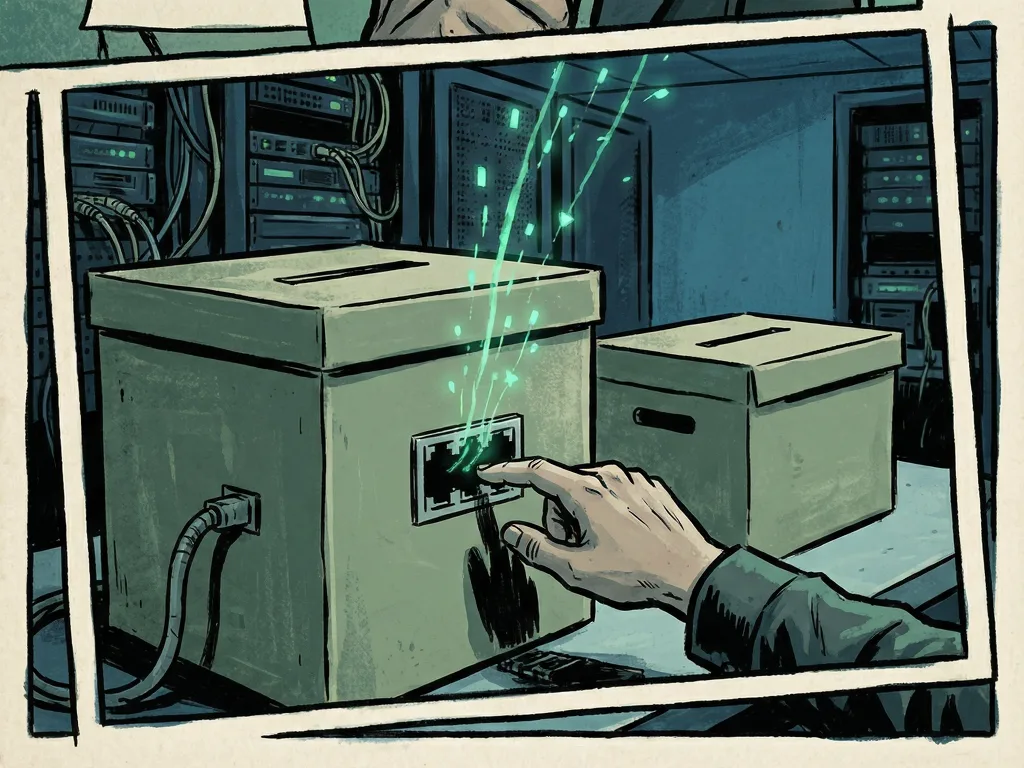
Cloudflare's telemetry shows government election websites faced website vulnerability attempts 180 times more often than denial-of-service (DDoS) attacks, and at roughly ten times the rate seen across Cloudflare's broader customer base. The company also found evidence of at least one attempt to exploit a recently disclosed critical PHP vulnerability on a state government voting website in the Western United States.
The data comes from organizations enrolled in Cloudflare's free cybersecurity programs — the Athenian Project, Cloudflare for Campaigns, and Project Galileo — which together protected more than 1,400 election-related websites during the 2026 midterms, including state and local government sites, candidates, political parties, voting-rights advocates, journalists, and civil society groups. Cloudflare launched its first election protection program in 2016 following widespread reports of cyberattacks targeting U.S. elections.
The attack curve peaked weeks before voting, not on Election Day
Vulnerability exploit attempts climbed steadily throughout 2026, from 200,000 per day in January to 2 million per day in October, with the peak arriving in late October — several weeks before the election. Over the 12 months leading up to the election, Cloudflare mitigated 392 million vulnerability attacks on government election websites alone.
On Election Day itself, Cloudflare detected no escalation in attack volume and zero major DDoS incidents across protected election sites. That is a sharp contrast with other recent elections, such as Moldova's in 2025, when the Moldovan Election Commission absorbed more than 898 million malicious requests in a single 12-hour period, with attacks peaking at 324,333 requests per second. The only significant DDoS attack in the U.S. cycle occurred on November 2, targeting a candidate for the U.S. House of Representatives in California, and totaled 520,000 requests.
Legitimate traffic told a different story. Ordinary user traffic to state and local government election websites reached approximately 602 million requests on November 3, up from 130 million on November 1 — a 363% jump — while traffic across the rest of Cloudflare's global network rose only 12% over the same period. Those government sites carry authoritative information on how to register, where to vote, and who won, which is precisely why they attract actors seeking to suppress turnout, disrupt results reporting, or steal sensitive data.
Why vulnerability attacks dominated — and what they target
Website vulnerability scans were by far the most common attack type Cloudflare observed in the 2026 cycle. These attacks exploit outdated or vulnerable website code to reach internal systems and data. Cross-site scripting injects malicious code into web pages to capture administrator credentials or deface content; SQL injection manipulates database queries, potentially allowing attackers to extract voter records or alter data.
The PHP disclosure added a fresh vector. On October 21, security researchers disclosed serious vulnerabilities known as php2shell in PHP, the open source back-end programming language used by 70% of the world's websites. The flaws reportedly could let attackers execute malicious code on vulnerable servers, expose customer data, or disrupt services. Cloudflare deployed Web Application Firewall (WAF) protections for all customers before the public disclosure. On October 22, Cloudflare's PHP defense triggered more than 9,000 times on a state government election website in the Western U.S. That attack was detected on only one election-related site and appears to have been an isolated incident rather than part of a broader trend.
Email threats were rarer but harder to catch
Phishing and other malicious emails targeting political campaigns occurred at rates consistent with Cloudflare's broader network but showed signs of sophistication. In the 90 days before the election, 3.9% of emails sent to organizations participating in Cloudflare for Campaigns were identified as malicious, closely tracking the 4.8% baseline across other Cloudflare customers. Nearly 42% of those malicious emails bypassed basic email authentication checks, such as verifying sender identity or preventing in-transit tampering — though Cloudflare's advanced phishing detection tools still identified them. That gap matters: basic authentication alone would have let a large share of these messages through.
Journalism and civil society saw the opposite pattern
For journalism and election-related civil society organizations, DDoS was the most common attack, not vulnerability scanning. Over the same 12-month period, Cloudflare mitigated over 10.8 billion DDoS requests targeting these groups. The largest single attack occurred on September 10, 2026, hitting a U.S.-based news organization with 3.04 billion requests. This aligns with Cloudflare research released earlier in the year finding that among all Project Galileo entities across 120 countries, DDoS was by far the most common attack, accounting for 81% of all attacks.
The divergence is instructive: government election offices hold data and infrastructure worth penetrating, while newsrooms and advocacy groups publish information whose availability adversaries want to interrupt. A single threat model does not fit the whole election ecosystem.
What the data does and does not establish
Several caveats are worth keeping in view. The figures describe only organizations enrolled in Cloudflare's free programs — a substantial sample at 1,400-plus sites, but not a census of U.S. election infrastructure, and not a measure of attacks on sites protected by other providers or none at all. The absence of major DDoS incidents on Election Day reflects what Cloudflare observed across its protected sites; it is not proof that no attacks occurred elsewhere. Likewise, the single PHP exploit attempt on one Western U.S. state site is characterized by Cloudflare as isolated, and the company reports no evidence of a broader campaign. The 42% authentication-bypass figure covers malicious emails that were still caught by advanced detection, so it should not be read as a success rate for attackers.
Recommendations for election-adjacent organizations
Cloudflare's guidance, drawn from the 2026 cycle and prior elections, centers on three points. First, prepare for surges in legitimate user traffic, since voter interest itself can overwhelm unprepared infrastructure and make essential election sites inaccessible; organizations should plan scalable infrastructure that handles Election Day increases without straining budgets or staff. Second, maintain security protections year-round rather than treating them as a seasonal measure around voting windows, because attacks occur across the entire cycle. Third, deploy automated defenses such as managed rules so new protections apply by default, as AI has made it easier for attackers to find and exploit new vulnerabilities.
The broader takeaway for readers — voters, campaign staff, local officials, journalists — is that the risk profile of an election cycle is not concentrated on a single day. The 2026 data shows the heaviest exploitation activity arrived in late October, Election Day produced no major denial-of-service event across protected sites, and the most common threat was quiet attempts to reach data rather than loud attempts to go dark. Keeping digital infrastructure stable, secure, and accessible has become a civic priority as officials, institutions, and the public increasingly rely on the internet for election services.
State and local election offices, political campaigns, party organizations, journalists, and voting rights groups can access Cloudflare's cybersecurity services at no cost through the Athenian Project, Cloudflare for Campaigns, or Project Galileo.
Last updated: November 2026, based on Cloudflare's published findings on the 2026 U.S. midterm elections.
Reader notes 0
- No notes yet. Corrections and first-hand test results are welcome.