
Sovereign AI value lies in controlling AI traffic, not just local GPU placement; auditability and token metering may create new telco revenue.
The core judgment is that the recent announcement from F5 and Telenor ASA offers a glimpse of a different telco future. F5 said Telenor AI Factory selected BIG-IP Next for Kubernetes, running on Nvidia BlueField-3 data processing units, as the AI service plane for its Nvidia-powered sovereign AI infrastructure. This is less a GPU story than a control-plane story: operators may earn revenue by governing AI traffic—tenant isolation, policy-based traffic control, real-time telemetry, and later token-aware metering—not by placing GPUs inside a country. The deal remains small, and much of the token governance is planned rather than deployed.
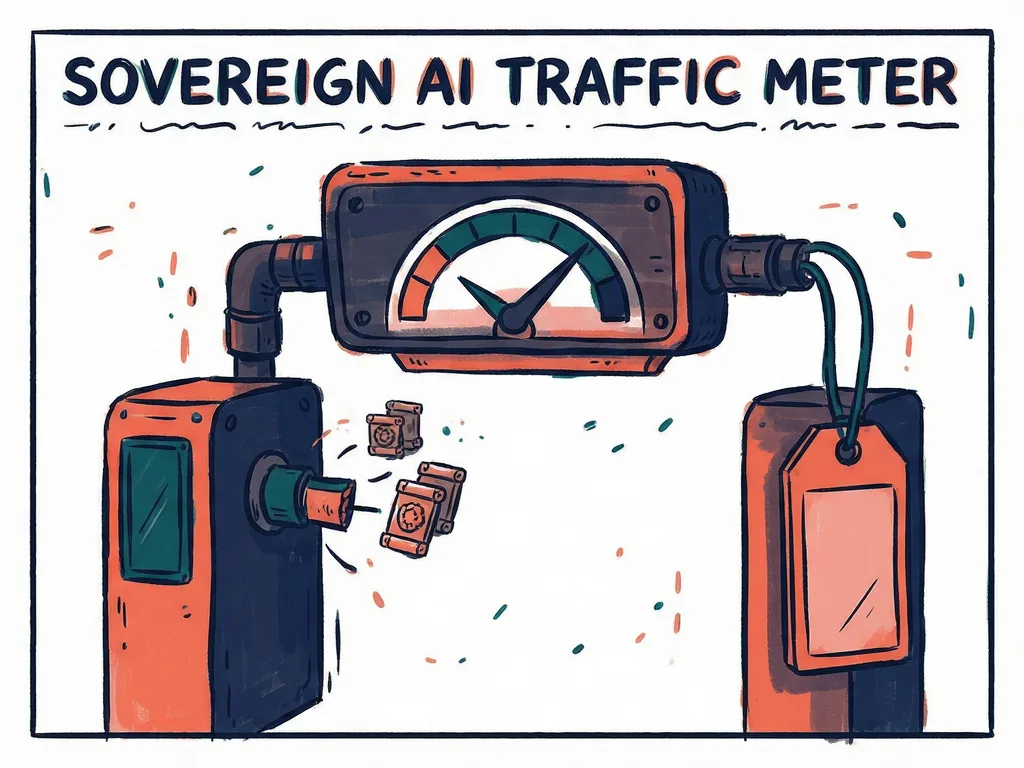
At MWC and other telco-related shows, the same line recurs: a new technology wave will let telcos create new revenue-generating services. Cloud, virtualization, software, and other trends were sold as the magic elixir. Instead, most operators used them to cut costs while still selling connectivity. The industry has spent two decades trying to avoid becoming a "dumb pipe," and for the most part, it has failed. AI could break that pattern, but only for operators that understand what they are selling.
The announcement is a service-layer bet
Telenor AI Factory selected BIG-IP Next for Kubernetes, running on Nvidia BlueField-3 data processing units, as the AI service plane for its Nvidia-powered sovereign AI infrastructure. The platform is designed for Norwegian and European organizations seeking high-performance AI services while maintaining control over where data is processed, stored, and accessed.
| Element | Detail from the source | Strategic meaning |
|---|---|---|
| Service plane | BIG-IP Next for Kubernetes on Nvidia BlueField-3 data processing units | Traffic control becomes part of the AI factory |
| Target users | Norwegian and European organizations | Sovereign AI is sold as controlled access |
| Launch controls | Multitenancy, isolation, policy-based traffic control, real-time telemetry | Makes usage auditable and separable across tenants |
| Roadmap | Token-aware governance, circuit breaking, inference-aware traffic optimization | Moves from infrastructure control to AI-native operations |
| Commercial status | Deal small; token governance planned rather than deployed | Direction is clear; revenue is not yet proven |
From the outset, F5 provides multitenancy and isolation, policy-based traffic control, and real-time telemetry for auditing and compliance. Telenor also plans to add token-aware governance, circuit breaking, and inference-aware traffic optimization as its commercial AI services scale. Sovereign AI becomes a product only when that control layer is operational, not when GPUs are merely delivered.
Sovereignty is an audit problem, not a postal code
Much of the sovereign AI conversation centers on GPUs located on national soil. That is important, but it is table stakes. A rack of GPUs in Oslo does not make an AI service sovereign if the operator cannot prove which tenant accessed what data, which model was called, and where the traffic went.
Ahmed Guetari, senior vice president and general manager of F5's service provider business, described sovereignty as "very vague and not always clear," then defined it as control, auditability, and observability. He separated data locality—data staying in-country—from sovereignty, which he framed as control over what happens to a customer's data and workload.
F5 argues it has spent two decades in the data path, deciding what an application can communicate with, enforcing security rules, and logging what happened. For a regulated bank or government agency, the ability to reconstruct exactly what happened after an incident is worth more than a press release about a data center's location. The Telenor choice signals that sovereign AI buyers may pay for provable control, not just national geography.
The token becomes the new billable unit
The more consequential idea is economic. Guetari argued that every successful technology business has found the right unit to monetize: cloud sells the CPU core, SaaS sells the seat, telcos once sold the voice minute and then the gigabyte. In his view, sooner or later that unit will be the token, and most telcos will have to move to the token. The ones that do not, he said, will be just pipes.
This creates a plausible path for mobile subscriptions. Guetari pointed to Chinese operators that have begun adding tokens to their plans and expected that within two to three years, a mobile subscription will include a token allotment, much like it includes a data allotment today. If that happens, telcos need to meter, govern, and bill token consumption with the same rigor they apply to minutes and megabytes.
F5 does not provide the billing systems, but Guetari noted that it feeds them the granular records they need, as it does today in mobile networks. Token-aware governance is therefore the bridge between an AI service plane and a commercial pricing model.
Enterprises care too. Guetari recalled CIOs telling him they had been "hit by the public cloud bill" and wanted to avoid a repeat with AI. Allocating tokens as a budget by user, model, or tenant turns AI from an open-ended expense into something a CFO can manage. For IT leaders, the practical question changes from "Can we run AI?" to "Can we see, limit, and attribute AI consumption?"
AI changes the data path from request to token load
The technical reason also matters. Traditional application delivery was built around a fairly predictable unit of work: the HTTP request. Now, an HTTP request can carry 10,000 tokens. Those tokens could be part of a bot or an agent, and the behavior is not the same at all. Without an atomic understanding of token load, Guetari said, operators are wasting the entire GPU cluster.
That is the case for an AI-aware service plane. GPUs are the most expensive resource in the building, and a load balancer that treats every request the same will leave capacity idle. Running F5's data plane on BlueField DPUs also offloads networking and security from host CPUs, whose real job is to keep the GPUs fed. Guetari said F5 has improved tokens per second, time to first token, and tokens per watt, the metrics that determine whether an AI factory makes money. The source gives no specific performance figures, so this should be read as a direction, not a benchmark.
Telcos have assets, but not the track record
Guetari did not sugarcoat the industry's record. He said that two years ago, telcos did not believe in the opportunity and did not see it. Indosat Ooredoo Hutchison, another F5 customer, is cited as one of the few operators to move early. Its early AI factory revenue came largely from selling bare-metal GPU capacity, while the company quickly recognized the need to build the software stack to offer sovereign AI services to banks and governments. The path to token-as-a-service may run through capacity deals first.
Telcos have long had the raw ingredients: power, space, distributed facilities, national trust, and enterprise relationships. What they lack is speed. Twenty years ago, a new service meant building a new network, so every initiative was scrutinized to death. Today, everything is software, but the approval culture has not changed. Hyperscalers experiment and kill what does not work. AI moves too fast for 18-month telco business cases. The risk is not missing assets; it is missing the operating rhythm.
Why F5 wants the AI factory story
There is an F5 story too. Guetari said telco accounted for 13% of product bookings in F5's most recent quarter, and that mobile core spending tends to come in waves, with a likely lull before 6G. He said he did not want to see F5's telco business stay stagnant or grow at one digit. AI factories give F5 a way to grow independently of the mobile cycle. Guetari said telco AI factory activity has accelerated sharply over the past three to six months.
F5 is not only a vendor inside a sovereign AI project; it is positioning itself for growth outside the traditional telecom hardware cycle. If token-aware service planes become standard for AI factories, F5 can attach controls to workloads that are not just web traffic or mobile core functions. The Telenor deal is small, but the category it points to is larger.
What this means for AI buyers and operators
Guetari captured the shift by saying that each application is consulting an LLM, so AI is part of the workflow. If a provider does not embed itself in that workflow, it will miss the market.
For IT leaders evaluating sovereign AI providers, the practical advice is simple: do not ask where the GPUs are. Ask how the provider controls, isolates, meters, and audits the traffic flowing to them. That question exposes whether a provider is selling a real service or a data-center lease.
For operators, the choice is sharper. If they treat AI factories as a real estate play, renting out GPUs by the rack, they may end up as pipes again, only with more expensive pipes. If they build a governed, metered, auditable service layer on top, they can sell something enterprises value more than bandwidth.
The unresolved part is execution. Both companies describe much of the token governance as planned rather than deployed. The token allotment in mobile subscriptions is an expectation within two to three years, not a delivered standard. The F5 performance improvements are described without hard numbers. The telco industry's 18-month business-case culture remains a drag. The direction is credible; the payoff is not guaranteed.
Source and update note
All facts above are drawn from the F5 and Telenor ASA announcement about Telenor AI Factory and the interview details attributed to Ahmed Guetari. The source does not provide a publication date. Last updated: not provided in the source.
Reader notes 0
- No notes yet. Corrections and first-hand test results are welcome.