
NVIDIA and Lambda reveal a production co-packaged optics cluster with 18 serviceable light sources, cutting power and scaling 10,000 GPUs.
The central conclusion is straightforward: co-packaged optics is no longer waiting for a future lab-to-production moment. At the SC26 conference, NVIDIA and Lambda described their first production co-packaged optics cluster, and the system is already in use across more than 10,000 GPUs. That matters because the industry has spent decades trying to move this architecture from test platforms into large-scale switch systems, and many observers have treated production use as still years away. The announcement therefore changes the question from whether co-packaged optics can be deployed to how quickly its adoption curve will expand.
Why This Deployment Changes the Conversation
The industry has worked to move co-packaged optics from the lab to production for decades. Many participants still describe it as a technology that is a few years away. The NVIDIA and Lambda disclosure contradicts that expectation. The cluster is not presented as a proof of concept, but as a production system already running today.
This matters because co-packaged optics attempts to solve a structural problem in large switch systems. In conventional front-panel pluggable optics, optical modules sit at the faceplate, while the switch silicon is farther away. High-speed electrical signals must travel through copper paths over relatively long distances before being converted into optical signals. Moving the optics closer to the switch package reduces those electrical paths. The disclosed design places the optics in the switch package rather than in front-panel pluggables.
The practical effect is power. The source states that this approach can significantly lower power consumption, allowing more GPUs to fit in the same footprint. In a power-limited environment, that changes the revenue calculation. More power available to GPUs directly affects the revenue that can be generated per watt of power available to the cluster.
The Key Design Choice: Making Light Sources Serviceable
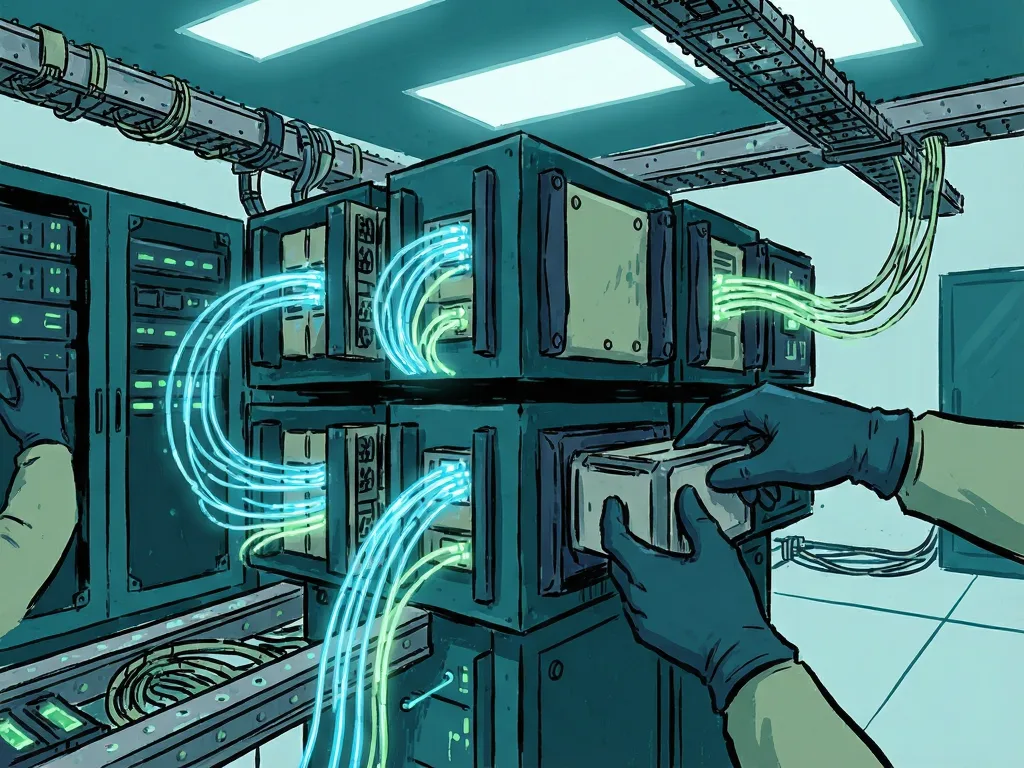
A major reason co-packaged optics has been slow to reach production is reliability. If a light source is integrated into a sealed switch package and it fails, the entire package can become difficult or impossible to maintain. The NVIDIA design described at Hot Chips 2025 addresses this with an array of 18 pluggable light sources on the front of the chassis. These light sources generate light that travels to the optical modules in the switch package.
The pluggable arrangement is important because light sources tend to be the parts that fail in pluggable optics. Making them serviceable removes one of the key inhibitors to production use. The switch package side also makes the connections at least somewhat serviceable, which helps deployment.
This is a subtle but decisive engineering point. The architecture does not simply move optics closer to silicon. It separates the failure-prone light generation from the switch package enough to allow maintenance. That separation makes the system viable in a data-center fleet, where field replaceability is as important as raw performance.
What the Quantum-X Switch Reveals About Scale and Cooling
NVIDIA’s first version of the packaging is in its Quantum-X switching product. Spectrum-X will be an updated second-generation part. The Quantum-X co-packaged optics switch has 144 optical ports, each at 800Gbps.
The source highlights a counterintuitive point: although the switch has 144 ports at 800Gbps, it uses only 18 light sources instead of 144 separate 800Gbps optical modules or 72 dual 800G modules. That means fewer light sources can fail than in a traditional switch, and it becomes easier to cool them than cooling a larger array of individual pluggable modules.
This comparison is useful because it reframes the reliability debate. In a traditional pluggable design, each front-panel module contains its own optical components, and many light sources or transceivers can fail independently. In the disclosed co-packaged optics design, the light generation is centralized into 18 serviceable sources, while the optical functions are integrated at the switch package. The result is not a simple reduction in component count, but a change in where failures can occur and how heat must be managed.
Specifications That Matter
| Element | Disclosed detail | Why it matters |
|---|---|---|
| Cluster size | More than 10,000 GPUs | Shows the technology is being used at production scale, not only in a single test unit. |
| Switch generation | Quantum-X is the first version; Spectrum-X is the updated second-generation part | Indicates a product roadmap rather than a one-off experiment. |
| Light sources | 18 pluggable light sources on the front of the chassis | Allows maintenance of the parts most likely to fail. |
| Optical ports | 144 optical ports, each at 800Gbps | Defines the switch’s external optical capacity. |
| Power effect | Can significantly lower power consumption | Frees power budget for GPUs in the same footprint. |
| Revenue logic | More power to GPUs affects revenue per watt | Connects infrastructure design to cluster economics. |
Neutral Pros and Cons
The advantages are concrete. The deployment demonstrates that co-packaged optics can exist in a production cluster. Serviceable light sources reduce the operational risk that has kept the technology in labs. Fewer centralized light sources can lower failure exposure and cooling complexity compared with a larger field of individual pluggable modules. Lower power consumption can increase GPU density within the same footprint, which is especially valuable in power-constrained facilities.
The limitations are equally important. The disclosure confirms existence, but it does not provide long-term fleet data, cost comparison, latency improvement, or vendor adoption rates. The switch package connections are described as at least somewhat serviceable, not fully interchangeable in the way a front-panel pluggable module is. Spectrum-X is identified as a second-generation part, but the text does not state that it is already deployed. The cluster’s production status answers the earliest question, but it does not prove that co-packaged optics will become the default architecture across the industry.
The Adoption Curve Is the Real Uncertainty
The source frames the moment bluntly: NVIDIA is at the forefront of deploying co-packaged optics. The cluster exists and is running today. That should settle the question of whether the technology can be deployed. The next question is adoption.
A production deployment does not automatically create a broad market. Operators will need to compare serviceability models, failure behavior, repair workflows, thermal limits, and supply-chain readiness against conventional pluggable switches. The second-generation Spectrum-X path suggests NVIDIA is not treating this as a one-time experiment, but the pace of replacement across other switch vendors and customer fleets remains unknown.
The observation from the Open Compute Project Summit 2026 adds context. A few weeks before the SC26 disclosure, another vendor’s keynote reportedly described co-packaged optics as still years away from deployment. The NVIDIA and Lambda cluster suggests that view is now outdated for at least one production environment. It also shows how quickly perception can lag behind hardware reality.
What Readers Should Take Away
For readers evaluating data-center infrastructure, the key takeaway is not that co-packaged optics is suddenly universal. It is that a major obstacle—serviceability—has been addressed enough to support a real cluster of more than 10,000 GPUs. The architecture moves optics closer to the switch package, centralizes 18 pluggable light sources, and connects them to a switch with 144 optical ports at 800Gbps each. If power savings and GPU density follow as the source describes, the technology can change cluster design economics. But the adoption curve, long-term reliability, and second-generation deployment status remain open questions.
Source note: This analysis is based on the supplied SC26 NVIDIA and Lambda discussion, coverage of NVIDIA’s Hot Chips 2025 presentation, and the reported Open Compute Project Summit 2026 keynote observation.
Last updated: November 2026.
Reader notes 0
- No notes yet. Corrections and first-hand test results are welcome.